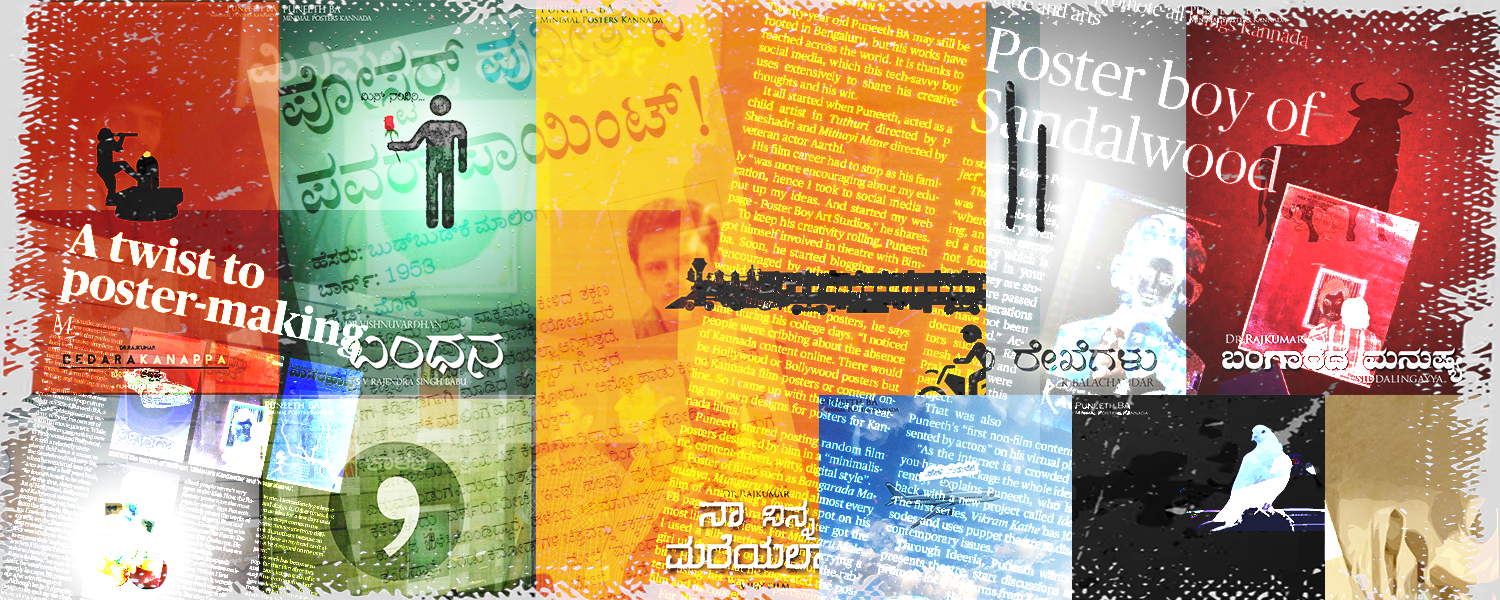
Sometimes an identity in the creative world begins quietly. What started as a small creative experiment slowly grew into a recognizable identity for us and Puneeth Amarnath, founder of Poster Boy Art Studios. The idea began on an ordinary evening, when he stumbled upon minimal movie posters from Hollywood. They were striking in their simplicity. The idea was powerful.
Despite the richness of Kannada films and their cultural legacy, minimal poster interpretations were almost absent. So, he decided to try it with no formal design training and an elaborate plan. But with just PURE enthusiasm. As the posters began appearing online, people slowly started noticing them. But what stood out was the nature of the response. People didn’t simply react to the visuals — they reacted to the memories behind them. For instance, a single symbol in a poster would remind someone of a favourite scene, and colour or object would take someone back to the first time they watched the film. Without intending to, the posters were triggering nostalgia. That discovery naturally pushed the work further. We began exploring films from different eras, especially old classics.
At that time, social media was far quieter than it is today. Even within those smaller circles, the engagement felt genuine. Some appreciated the effort, and a few suggested films to explore next. Others shared their own interpretations of how a film could be visually represented. Slowly, the posters had become a conversation with the audience. As the conversations grew, so did the work. Designing posters became a daily rhythm. Some days saw two or three designs being created, while on others the number went even higher. What had started as curiosity slowly turned into an almost obsession. Outside the digital space, however, the reactions were quite different. Friends, family members, and colleagues often wondered why so much time was being spent on something that appeared to be just a hobby. But the work continued. Within a year and a half, more than 800 minimal posters had been created. And somewhere during that period, the posters began reaching places we had never expected.
The posters slowly found their way into the Kannada film community. Directors, actors, and filmmakers began noticing the work. Some appreciated the ideas behind the posters, while others shared them on their own social media platforms. Those small moments of acknowledgement meant a great deal. One particularly memorable moment came when a follower, based in the United States, showcased one of his favorite posters to actor Diganth, who was in the US for an event, and posed for a picture with it. Another moment followed when Kiccha Sudeep retweeted and made a comment on one of the posters. Soon after, Prakash Raj shared one of the posters on his Twitter account. Ramesh Arvind, Yogaraj Bhat, Rajendra Singh Babu, Rockline Venkatesh, Jayamala and many veterans from the Kannada Industry found the concepts fresh and innovative. Filmmakers like Pawan Kumar, K. M. Chaitanya, Simple Suni, Sachin Ravi, Gaurish Akki, Vijaylakshmi Singh and Hemanth Rao, along with actors such as Rakshit Shetty, Naveen Krishna, Ninasam Sathish, and Shruti Hariharan, also began sharing the posters on their platforms.
Gradually, the work began gaining visibility within the film ecosystem. And with that, visibility came new possibilities. The growing attention soon translated into opportunities. Filmmakers began approaching our studio to design visuals for their films. One of the early collaborations came with Bahuparak, directed by Simple Suni and starring Srinagar Kitty and Meghana Raj. Minimal visual elements were incorporated into the film’s title sequence, appearing behind the rolling credits. Later, Godhi Banna Sadharana Mykattu also used minimal posters as part of its promotional campaign. What was interesting, however, was the nature of these requests. People were not approaching us for conventional design work. What attracted them was the approach itself — a minimal, concept-driven way of communicating an idea through visuals. By then, the style had quietly started becoming an identity.
The influence of the posters soon began appearing in places we never expected. Engineering college festivals started using these designs in Kannada cinema quiz rounds. Organisers would hide the film title and ask participants to identify the movie purely through the visual clue. The posters had slowly turned into recognisable cultural references. It also appeared as a poster prop in a blockbuster Kannada song from Kirik Party, Belageddu.
Another meaningful milestone came when The Indian Express and Sakhi organised an event called Salaam Cinema to honour state film awardees. As part of the event, a dedicated space was created to exhibit minimal Kannada posters. Filmmakers, artists, and visitors spent time exploring the work and the ideas behind it. The minimal Kannada poster series eventually expanded beyond digital platforms as well. A column titled Posterikarana appeared in Vishwavani, where one poster would be featured every week. Iruve Merchandise Store created a platform where fans could buy prints of the posters. Later, brands like Aralikatte collaborated to transform these visuals into Kannada-inspired products. Designs inspired by cultural elements such as Somanakunitha, Yakshagana, Kannada stars and their pop references and Gubbimari appeared on pillow covers, saree patterns, blouse designs, curtains, magnets, and badges.
By this point, the posters had already created a strong presence online. Followers and friends had even begun referring to him as “Postar Boy Puneeth” or “PoStar Puneeth” on social media.
Looking back, the posters had quietly traveled from screens to physical spaces. What began as a quiet experiment had slowly grown into a visual language for celebrating Kannada cinema. Minimal posters were never meant to become an identity. But sometimes, when an idea is simple, honest, and consistent, it finds its own path. And in our case, it became more than just design. It became an identity for both the project and the creator behind it. This also paved a path of confidence and foundation for Puneeth to later establish Poster Boy Art Studios, a content company.
a collaboration, an appreciation, or even a what-if!
© 2026 | Poster Boy Art Studios Pvt Ltd